

Posted: 3rd June 2026
A Place for Purpose
Let’s talk about Social Value
Spot light on the last 21 years
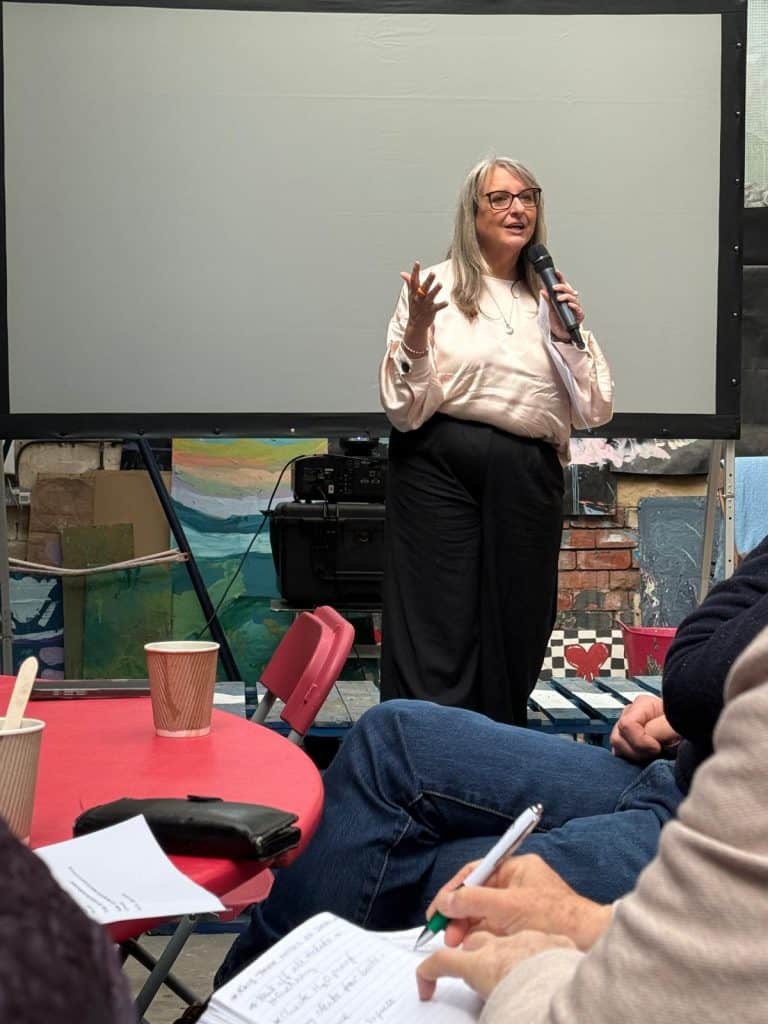
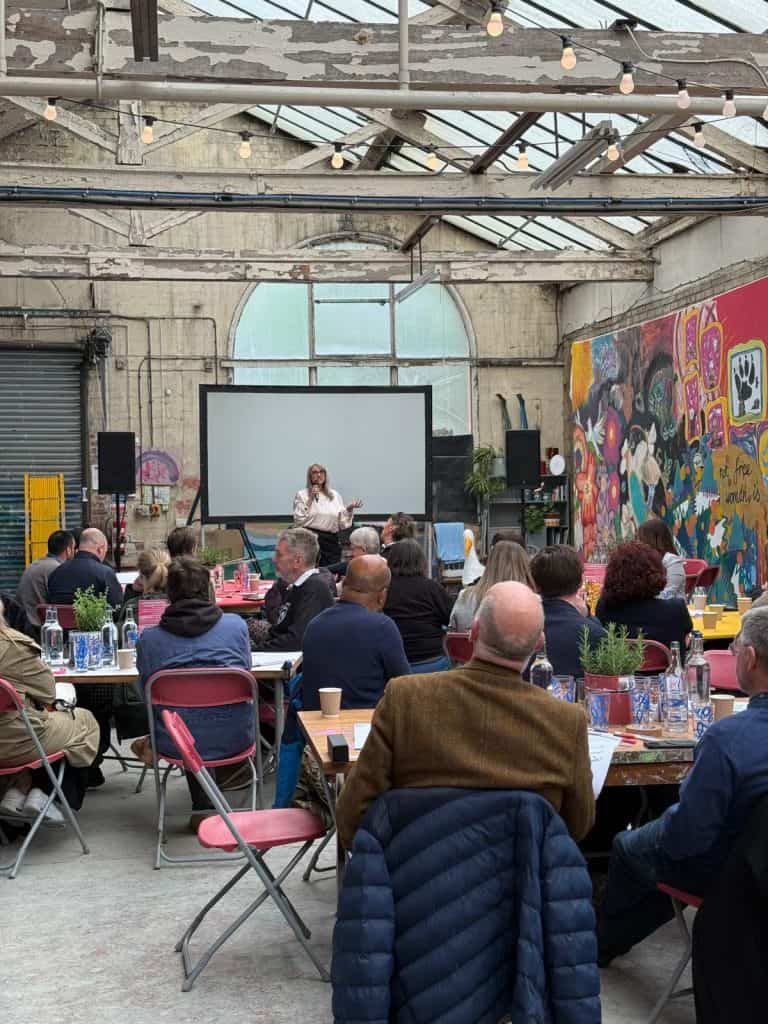
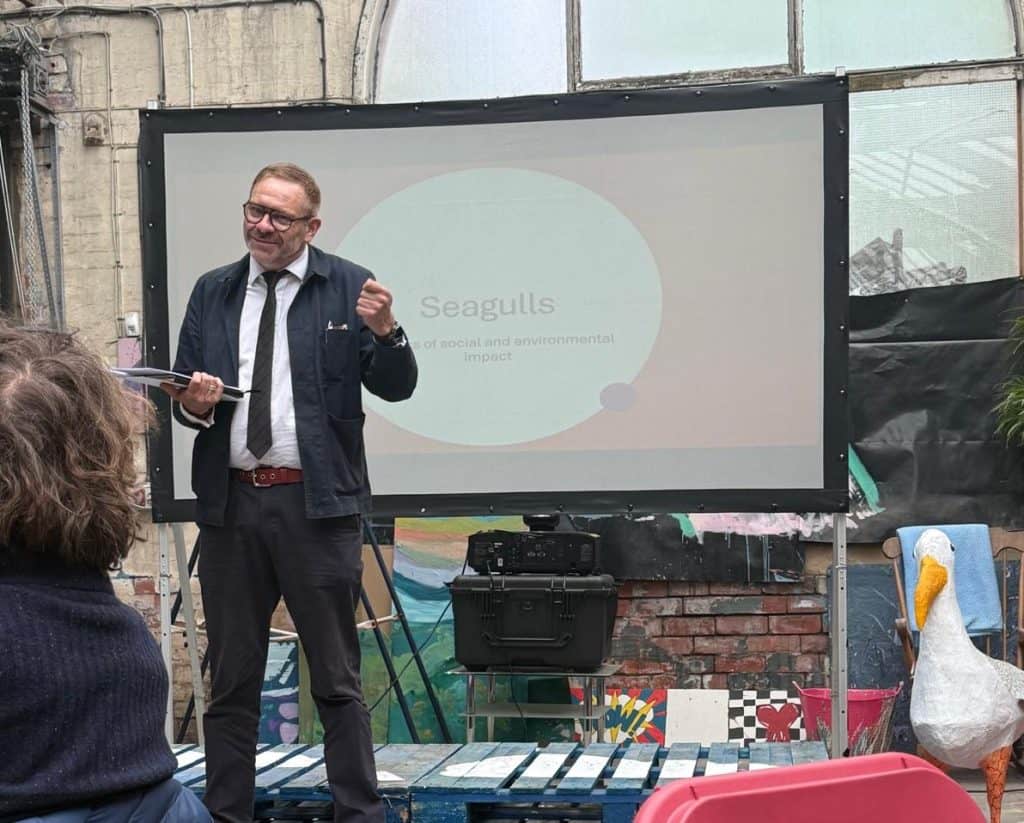
On May 14th we hosted an event at Seagulls in collaboration with Lucinda Yeadon and Social Value Engine. The event highlighted the ongoing development of Social Value measurement as well as the work that we at Seagulls have been doing for the last 21 years to impact society, the environment and the local economy in Leeds.
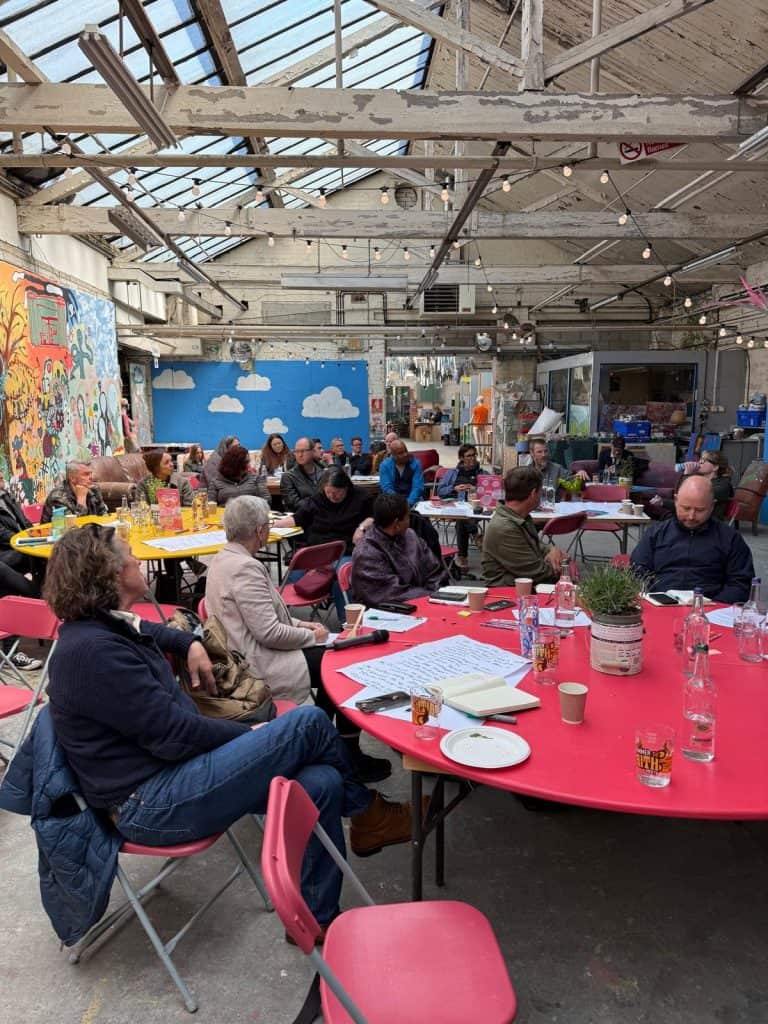
A Place for Purpose was a gathering of charities, social enterprises, and purpose-led organisations in Leeds and Yorkshire who want to move from good intentions to measurable outcomes.
Lucinda brings over seven years of hands-on social value practice, including £11 million in measured social value through her work at CEG, and a background as former Deputy Leader of Leeds City Council. She is a powerhouse of expertise and connections for Social Value. Seagulls feel very lucky to have her as a key supporter and advocate.
Attendees took part in a collaborative workshop to build a shared measurement framework for the region (more on this to follow).
Growth, resilience and security
The days Keynote Speaker was the brilliant Peter Holbrook CBE. Peter is the CEO of Social Enterprise UK, the UK’s national body for Social Enterprise. Peter campaigns, advocates, supports and enables Social Enterprise’s (and the sector) to grow and respond to the times. We were very grateful for his time and passion at the event.
Peter delivered an impactful speech that summed up the purpose of the day and gave valuable insight into the National picture. He has given us permission to publish the speech and so we recommend you grab a cuppa and have a read. Thank you Peter (and no we didn’t pay him!)
Full speech transcript
Good afternoon, everyone.
It is a real pleasure to be here in Leeds, and a particular pleasure to be here at Seagulls.
And let me begin by saying thank you to Cat Hyde. Cat is one of those people who slightly ruins the rest of us for excuses. She saw waste, and built value. She saw people being pushed to the edges, and built routes back in. She saw environmental damage, social injustice and economic failure sitting in the same paint tin, and rather than writing a strategy paper called “Towards a More Integrated Framework for Pigmented Circularity”, which, let’s be honest, someone somewhere absolutely would have commissioned, she got on with it.
That is Seagulls.
Paint with purpose.
Not paint with a corporate social responsibility appendix. Not paint with a commemorative tote bag. Paint with purpose. Paint that has been rescued, remixed, re-used and returned to life. Paint that says something about the kind of economy we need: practical, rooted, creative, inclusive, and frankly a great deal more colourful than the one we have been offered.
Today’s title is “Growth, resilience and security.” And I want to frame those three words around a phrase we have been using at Social Enterprise UK: the backbone of Britain.
Because when people talk about the backbone of Britain, they often mean something like tradition, grit, duty, small businesses, local institutions, everyday decency, and people getting on with things without fuss. Which is a very British phrase, “without fuss.” It usually means someone has quietly done the work of five departments, two ministers and a procurement framework, and then apologised for the biscuits.
And, all of that matters.
But if we are serious, the backbone of Britain is not a slogan. It is not a Union Jack on a lectern. It is not a stock photo of a hard hat next to a cup of tea. It is the organisations that hold communities together when markets fail, when public systems are stretched, and when people are told, yet again, to wait their turn.
It is the youth worker who notices the child no one else has noticed.
It is the community business keeping a high street alive.
It is the care provider paying people properly because dignity cannot be delivered by an exhausted workforce on poverty wages.
It is the social enterprise creating work for people who have been written off.
It is a place like Seagulls, taking something that was going to be wasted and turning it into affordable materials, skills, confidence, jobs, creativity and belonging.
That is not soft. That is not marginal. That is not a “nice to have.”
That is national resilience.
And we need to say so with more confidence.
Let me start with growth.
Growth has become one of those words in public life that everyone uses, but very few people define. It is wheeled out in speeches like an elderly relative at a wedding: everyone is pleased to see it, no one is quite sure where it should sit, and by the end someone will probably claim it has solved the seating plan. And if you ask what kind of growth, there is often a pause, the kind of pause you get when someone has just realised their entire economic policy is basically “more”.
But growth matters. Of course it does. We need stronger local economies, good jobs, rising productivity, investment, enterprise and ambition. The question is not whether we need growth. The question is: what kind of growth, for whom, and at what cost?
Because growth that extracts from communities is not the same as growth that roots wealth in them.
Growth that burns through people is not the same as growth that develops them.
Growth that treats nature as an accounting error is not the same as growth that respects the limits of the planet.
Social enterprises exist to answer that question differently.
Across the country, social enterprises are proving that business can be commercially serious and socially committed at the same time. In the latest State of Social Enterprise evidence, 48% of social enterprises reported increased turnover in the previous 12 months, compared with 36% of small businesses. In the same evidence base, 37% increased staff numbers, and 46% expected to employ more people in the next year.
That matters. It matters because these are organisations trading in tough markets, in tough places, often with tougher missions. They are not growing by ignoring disadvantage. They are growing by tackling it.
And that is what makes places like Seagulls so important.
The conventional economy looks at leftover paint and sees a disposal problem. Seagulls looks at it and sees a supply chain, a shop, a workshop, a volunteer opportunity, an environmental intervention, a route into employment, a reason for people to gather, and, quite possibly, a shade of blue that no human being could have planned but somehow works perfectly in a downstairs loo. That is the difference between a system that says “bin it” and a community that says “hang on, this might still have a life.”
That is entrepreneurial insight.
It is also economic common sense.
At the start of 2025, the UK had an estimated 5.7 million private sector businesses. SMEs made up 99.85% of them, employed 16.9 million people, and generated £2.8 trillion in turnover. So, when we talk about the future of the economy, we are not only talking about the FTSE 100, the City of London, or whatever the Chancellor has found behind the fiscal sofa this week. We are talking about the millions of enterprises that make places work.
The challenge is that too much of our economic conversation still behaves as if purpose is a drag on performance.
It is not.
Purpose can be a discipline. It can sharpen choices. It can build trust. It can attract staff, customers, partners and investors who want to know that their time and money are doing something useful in the world. Not “purpose” as in the word you put on slide two before behaving exactly as you did before, but purpose as in the thing that changes what you do on a wet Tuesday when nobody is applauding.
At Seagulls, purpose is not painted on after the business model has dried. It is mixed in from the start.
And that brings me to resilience.
Resilience is another word that has had a hard few years. It has been asked to do a lot of heavy lifting. Sometimes it is used to mean “communities doing unpaid crisis management because systems have failed them.” Sometimes it means “please absorb this shock quietly while we form a taskforce.” And sometimes it means “we have cut the safety net, but we do admire your balance.” At that point, resilience stops being a virtue and starts sounding like a very polite mugging.
That is not good enough.
Real resilience is not just the ability to endure damage. Real resilience is the capacity to adapt, to organise, to care, to trade, to learn, and to build something stronger before the next crisis arrives.
And social enterprises are resilience institutions.
They are close enough to communities to understand what is changing. They are enterprising enough to respond. They are values-led enough to protect the people who are usually treated as expendable. And they are practical enough to know that hope without delivery is just a very nicely worded poster.
Look at Seagulls’ own impact.
In 2024 alone, Seagulls saved nearly 440 tonnes of paint from landfill. Volunteers contributed 4,325 hours. And 99% of workshop attendees said they would return.
Those numbers tell us something important.
They tell us that environmental action can be tangible. You can see it stacked on a shelf. You can stir it. You can put it on a wall.
They tell us that volunteering is not a decorative extra. It is part of the social infrastructure of a place.
They tell us that people do not only need services. They need agency, creativity, relationships and the chance to be useful.
And they tell us that when you build something with integrity, people come back.
There is a national story here too.
The Royal Society of Chemistry has estimated that UK households are sitting on more than 50 million litres of unused paint. Every year, the UK generates around 55 million litres of waste decorative paint. And only around 2% is currently reused, recycled or remanufactured, with the rest landfilled or burnt. Paint is one of the few policy areas where “watching it dry” would actually be an improvement on what currently happens next.
Now, even by British standards, that is an absurd sentence.
We are a country that can organise a four-hour televised debate about whether a sandwich is lunch, tea, or an attack on regional identity. Yet somehow, we have normalised a system in which millions of litres of usable material are left in cupboards, garages and sheds until they become a problem someone else has to pay to dispose of. That is not a circular economy. That is a national collection of guilty utility rooms.
Seagulls shows there is another way.
Not in theory. In practice.
This is circular economy with sleeves rolled up. It is not a diagram with arrows chasing each other around a PowerPoint slide. It is people collecting, checking, mixing, selling, learning and creating.
And it is exactly the kind of practical innovation Britain needs.
Because resilience is not built by nostalgia. It is built by capability.
It is built by organisations that can take shocks and still create value.
It is built by people like Cat, and teams like this one, who make something hopeful without pretending the world is easy.
That takes us to security.
Security is often spoken about in narrow terms: borders, defence, policing, energy supply. Those things matter. But they are not the whole story.
For most people, security is also whether their community has somewhere to go.
Whether their child can find support.
Whether work is decent.
Whether the high street has life in it.
Whether the air is breathable, the home is warm, the rent is payable, and the future feels like something more than a threat arriving in instalments.
Security is belonging. Security is trust. Security is the knowledge that if things get difficult, you are not on your own.
And that is why the civic and social sector leaders in this room matter so much.
You are not operating at the edge of national life. You are helping to hold its centre.
The phrase “backbone of Britain” is not just a compliment. It is a challenge.
If social enterprises, charities, community businesses and civic institutions are part of the backbone of Britain, then we have to treat them like backbone. We cannot keep asking them to carry more weight while giving them less support, less certainty and less respect.
A backbone needs nourishment. It needs strength around it. It needs systems that understand its importance.
That means better commissioning.
It means procurement that values social and environmental outcomes, not just lowest unit cost and the magical thinking that quality will somehow survive a race to the bottom. Lowest cost procurement often has the moral imagination of a supermarket self-checkout: technically functional, frequently baffled, and somehow always asking someone unpaid to fix the problem.
It means finance that fits the realities of mission-led business.
It means public policy that sees social enterprises not as a footnote to growth, but as one of the ways growth becomes legitimate.
And it means local leadership that is prepared to back the builders.
So, if national and local government want to make this change real, there are four practical priorities.
First, put social value into the hard wiring of public spending. Not as a warm paragraph near the end of a tender, but as a serious test of how public money builds local wealth, creates decent work, reduces waste and improves lives. If public money is being spent, it should strengthen the public good.
Second, make it easier for social enterprises to access the finance and premises they need to grow. That means patient capital, better use of public and community assets, meanwhile use of empty buildings, and investment that understands that mission-led organisations often create value before they can easily monetise it.
Third, build circular and social enterprise into local economic strategies. Every council and combined authority should be asking: what are we throwing away that could become local value? What contracts could create jobs for people facing barriers? What high streets, industrial estates and community spaces could become platforms for purposeful enterprise?
And fourth, treat social enterprise as part of economic security. Bring social enterprises into resilience planning, net zero delivery, skills strategies, health creation and neighbourhood renewal. Not as consultees after the decisions have been made, but as partners in designing the answer.
These are not extravagant ideas. They are practical, affordable and, in many places, already happening. The task now is to move them from exceptional examples into normal practice.
Because if we want growth, resilience and security, we should invest in the people already producing all three.
We should back the organisations creating jobs for people facing barriers.
We should back the businesses cutting waste and carbon.
We should back the community anchors that keep people connected.
We should back the entrepreneurs who know their place, know their mission and know that profit is not the enemy of purpose, but should be made its servant.
Cat and the Seagulls team have been doing this for years.
Long before circular economy became fashionable, they were circular.
Long before ESG became a boardroom acronym capable of making even a spreadsheet look nervous, they were doing environmental, social and governance work in the real world.
Long before “levelling up” became a slogan, a department, a row, a rebrand and then a sort of national shrug, they were taking practical action to make opportunity more visible and more reachable in this city.
That deserves celebration.
But it also deserves replication.
Because the lesson of Seagulls is not simply “isn’t this lovely?”
The lesson is: this works.
It works environmentally, because reuse reduces waste and cuts demand for new materials.
It works socially, because people who are invited into purposeful activity often rediscover confidence, connection and direction.
It works economically, because affordable products, local trading and job creation keep value circulating.
And it works democratically, because places like this rebuild trust from the ground up.
Trust is not restored by press release. Trust is restored when people see promises made visible.
A shop that helps you afford to decorate your home.
A workshop that makes you feel welcome.
A volunteer project that gives you a role.
A social enterprise that says the planet matters, and then proves it by saving hundreds of tonnes of paint from waste.
This is what hope looks like when it has a stockroom.
And I think that is the heart of today.
Hope is not optimism. Optimism is a mood. Hope is a practice.
Hope is what you do when the evidence is mixed, the money is tight, the policy environment is uncertain, and the paint tins are, frankly, everywhere. Hope is not a scented candle. It is a rota, a van, a ledger, a volunteer shift, a difficult conversation and, occasionally, a lid that absolutely refuses to come off.
Hope is deciding that waste is not inevitable.
Hope is deciding that people are not disposable.
Hope is deciding that places are not condemned to decline because a spreadsheet in another city has failed to recognise their worth.
Hope is Cat Hyde, around a kitchen table, with others, asking: what can we do with what we have?
And then doing it.
So my message today is simple.
If we want Britain to grow, we need enterprises that grow value in the places where people live.
If we want Britain to be resilient, we need organisations that can turn crisis into capability, waste into resource, and isolation into community.
If we want Britain to be secure, we need to strengthen the civic, social and economic institutions that give people confidence that the future can still be shaped.
That is the backbone of Britain.
Not abstract. Not sentimental. Not waiting for permission.
It is here in Leeds.
It is here at Seagulls.
It is in the volunteers, staff, customers, partners and supporters who have helped build this place.
It is in every organisation represented in this room that refuses to choose between enterprise and justice, between commercial discipline and human dignity, between environmental responsibility and economic ambition.
And it is in the work still ahead of us.
So let us leave here not only encouraged, but committed.
Committed to telling this story with more confidence.
Committed to backing social enterprises not as worthy exceptions, but as vital engines of the economy we need.
Committed to building growth that is shared, resilience that is real, and security that people can feel in their daily lives.
And committed to remembering that sometimes national renewal does not begin with a grand announcement from Westminster.
Sometimes it begins with a half-used tin of paint, a stubborn belief in people, and a leader like Cat Hyde saying: “We can do something better with this.”
Thank you.
Donate to make a difference over the next 20 years
Donations help us carry on the valuable work we do and we appreciate any amount that you’re able to give. If you’d like to support us in another way, come roll up your sleeves and consider volunteering.